Hot Searches: Color Doppler Ultrasound Probe Puncture Rack

scroll down
Latest Products

Major Announcement! Adjustments to Large-Scale Medical Equipment Configuration Planning Released
Release time:
2025-03-12 09:41
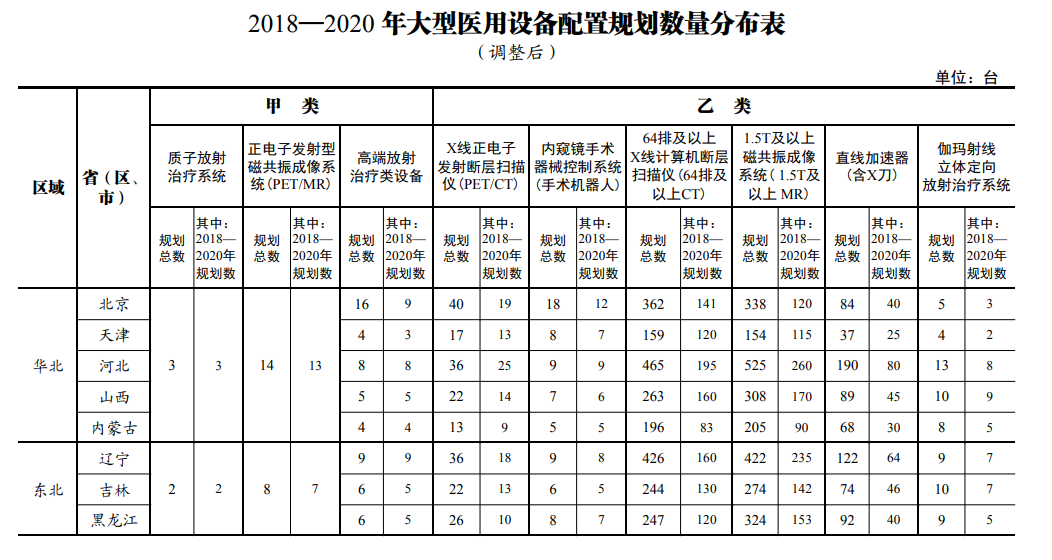
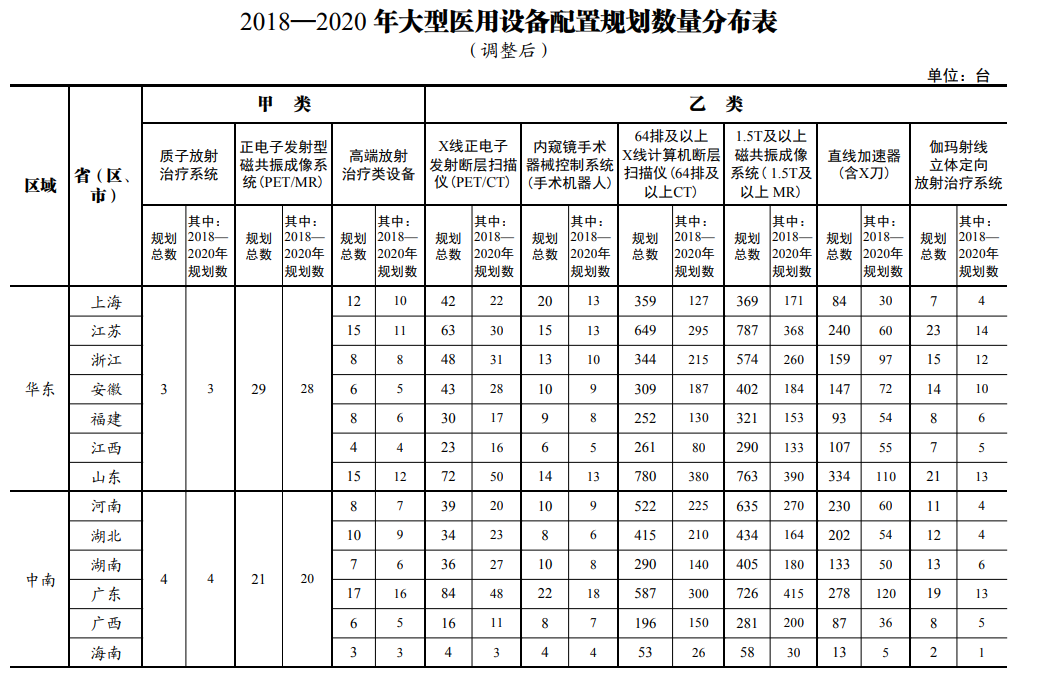
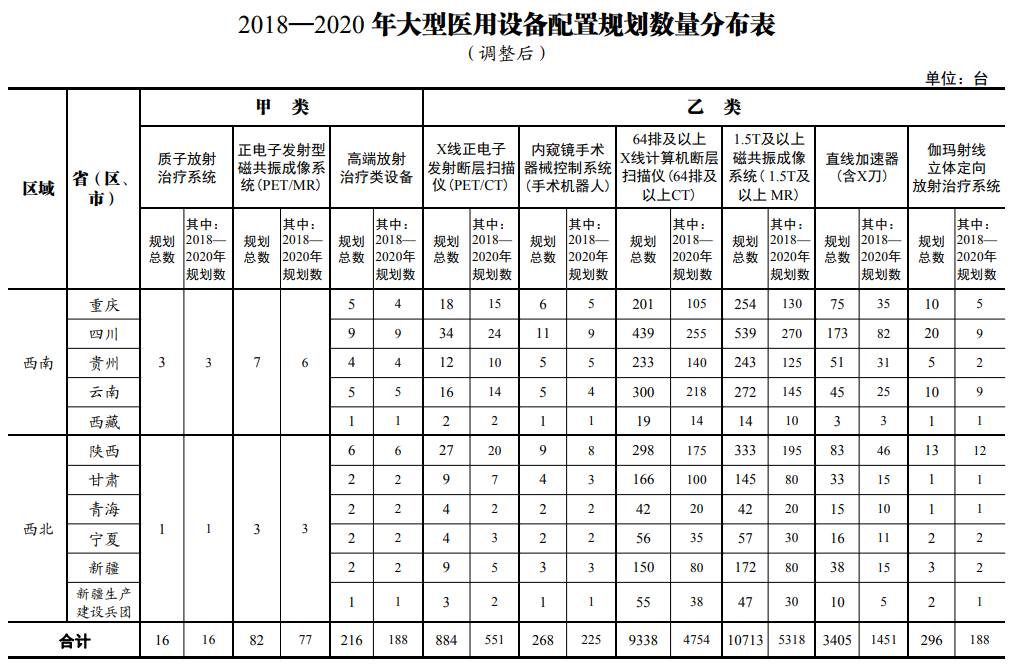
On August 4th, the Pharmaceutical Network reported that on July 31st, the National Health Commission issued a notice (Guowei Caiwu Han [2020] No. 315, hereinafter referred to as the "Notice") on adjusting the 2018-2020 plan for the configuration of large medical equipment. After the adjustment, the plan for the configuration of Class A and Class B large medical equipment from 2018 to 2020 is 12,768 units, including 281 units of Class A large medical equipment and 12,487 units of Class B large medical equipment. Compared with the original plan, there is a net increase of 2,671 units. Local authorities are required to formulate specific implementation plans or work plans based on the adjusted plan and local conditions to ensure the efficiency of plan implementation.
So, what impact does this plan adjustment have on medical resources in various regions? This analysis will briefly examine the regions receiving the increased resources and the types of resources added.
1. 55 additional Class A large medical equipment units. Including proton therapyTumorsystems, positron emission tomography/magnetic resonance imaging (PET/MR) systems, and high-end radiotherapy equipment. Except for high-end radiotherapy equipment (with an unchanged increase of 188 units from the original plan), the other two types have increased. Six proton therapy tumor systems have been added, with one each allocated to North China, East China, Northeast China, and Southwest China, two to Central South China, followed by four to Central South China, three each to North China, East China, and Southwest China, and two to Northeast China, and one to Northwest China.
The number of positron emission tomography/magnetic resonance imaging (PET/MR) systems has surged from the originally planned 28 to 77, ultimately reaching 82. The additional 49 units have been allocated as follows: 8 to North China, 4 to Northeast China, 20 to East China, 12 to Central South China, 3 to Southwest China, and 2 to Northwest China. Ultimately, the plan includes 28 in North China, 20 in Central South China, and 13 in North China, accounting for nearly three-quarters of the total number of positron emission tomography/magnetic resonance imaging systems.
2. 2,616 additional Class B large medical equipment units, including 174 positron emission tomography/computed tomography (PET/CT, including PET) scanners, 71 endoscopic surgical instrument control systems (surgical robots), 1,219 64-slice and above computed tomography (64-slice and above CT) scanners, 867 1.5T and above magnetic resonance imaging (1.5T and above MR) systems, 243 linear accelerators (including X-knives), and 42 gamma ray stereotactic radiosurgery systems.
Considering the increased number of Class B large medical equipment, 1,219 64-slice and above computed tomography (64-slice and above CT) scanners and 867 1.5T and above magnetic resonance imaging (1.5T and above MR) systems rank first and second, accounting for nearly 80% of the total increase in Class B large medical equipment. However, from the perspective of growth rate, positron emission tomography/computed tomography (PET/CT, including PET) scanners and endoscopic surgical instrument control systems (surgical robots) rank first and second, with an increase of 46.1%.
This "result" also "upholds" the goals and principles of this plan adjustment.
The Notice points out that the overall goal of this adjustment to the large medical equipment configuration plan is to further optimize the configuration of large medical equipment, promote the scientific and rational allocation of medical resources, and adapt tohealththe new situation of the development of the health industry, better meet the multi-level and diversified medical service needs of clinical diagnosis and treatment, medical research, and the general public, and also implements the provisions of the "People's Republic of China Basic Medical and Health Promotion Law": The competent departments of health and health in the State Council and the people's governments of provinces, autonomous regions, and municipalities directly under the Central Government shall, in accordance with the advancement, suitability, and accessibility of technology, formulate plans for the configuration of large medical equipment to promote reasonable configuration and full sharing of medical equipment within the region.
The Notice points out that there are four main principles for this plan adjustment: First, to coordinate the prevention and control of epidemics and economic and social development, optimize the supply of medical services, promote the accelerated innovation and development of medical technology, meet the needs of a better life for the people, and win the decisive victory in building a moderately prosperous society in all respects. Second, to fully utilize the important role of large medical equipment configuration planning management in the regulation of health and health resources, promote the scientific flow and rational allocation of health and health resources, and ensure a smooth transition to the next round of large medical equipment configuration planning. Third, to accelerate the clinical application of new equipment and new technologies, improve the emergency treatment capacity for major public health emergencies, and promote improvements in the quality and efficiency of medical services, and safeguard the safety of medical services for the people. Fourth, to support the standardized and healthy development of private medical institutions, promote the accelerated development of a diversified medical structure, and meet the diverse, differentiated, and personalized needs of medical services of the people.
In terms of "supporting the standardized and healthy development of private medical institutions," the Notice painstakingly devotes a section in the "relevant requirements" to point out that reforms are required such as the implementation of an informed consent system for the configuration of Class B large medical equipment by private medical institutions and the implementation of a filing system for the configuration of Class B large medical equipment by private medical institutions in free trade zones to support private medical institutions in configuring large medical equipment. However, whenever government departments issue plans to increase configuration, private medical institutions always worry about the limited medical resources being more occupied, and this time is no exception. It is expected that local government health and health administrative departments will leave more space for private medical institutions to survive and develop when implementing the planned allocation, and implement "supporting the standardized and healthy development of private medical institutions" in the specific plan.
Attachment:
Adjustment, equipment, planning, medical, large-scale, configuration, addition, meeting, system, medical
Contact Us
Room 618, 36 Gaoke Road, Tianhe District, Guangzhou, China
national unified free service hotline:400-020-6788


Copyright©2025 All Rights Reserved of Rencheng (Guangzhou) Medical Equipment Maintenance Co., Ltd.