Hot Searches: Color Doppler Ultrasound Probe Puncture Rack

Latest Products

Ultrasonic phased array technology
Release time:
2025-03-12 09:37
Basic Concepts
Ultrasonic phased array imaging technology achieves sound imaging by controlling the time delay of excitation (or reception) pulses in each element of the transducer array, changing the phase relationship of sound waves emitted (or received) by each element arriving at (or coming from) a certain point in the object, and changing the focal point and beam direction. Because the delay time of the phased array elements can be dynamically changed, the main advantages of using ultrasonic phased array probes for flaw detection are its controllable sound beam angle and dynamic focusing capabilities.
In ultrasonic phased arrays, each element is excited by the same pulse with different delay times, and the deflection angle and focus are controlled by controlling the delay time. In fact, the rapid deflection of the focal point makes it possible to perform two-dimensional imaging of the specimen.
Ultrasonic phased array detection technology has the following characteristics:
(1) Generates controllable sound beam angles and focal depths, enabling the detection of defects in complex structures and blind zones.
(2) Achieves high-speed electronic scanning through the combination of local chip units; with mechanical fixtures, high-speed, all-round and multi-angle detection of specimens can be achieved.
(3) Using the same pulse voltage to drive each array unit, the actual sound field intensity in the focal area is much greater than that of conventional ultrasonic testing technology, so higher detection frequencies can be used for materials with the same sound attenuation characteristics.
Ultrasonic Phased Array Working Principle
The digital control technology in phased array ultrasonic imaging systems mainly refers to the spatiotemporal control of the beam. Advanced computer technology is used to perform precise phase control of the phased beam in the transmitting/receiving state to obtain optimal beam characteristics. These key digital technologies include phased delay, dynamic focusing, dynamic aperture, dynamic aberration correction, coded emission, and beamforming.
Phase Delay
Phased array ultrasonic imaging systems use array transducers, and by adjusting the phase delay of the transmitting/receiving signals of each element, the curvature, direction, and aperture of the synthesized wavefront can be controlled to achieve various phased array effects such as beam focusing, deflection, and beamforming, resulting in clear imaging. It can be said that phase delay (also known as phased delay) is the core of phased array technology and the basis of various phased array effects.
Dynamic Focusing
Phased array focusing principle (as shown in the figure): The phased array transmission focusing principle is shown in the figure. Let the element center distance be d, the array transducer aperture be D, the focal point be P, the focal length be f, and the medium sound speed be c. According to the geometric path difference, it can be calculated that in order for the waves emitted by each element to focus at point P.
(a) Transmission Focusing Diagram (b) Reception Focusing Diagram

Schematic diagram of phased array focusing principle
Phased Array Detection Equipment
Phased array detection equipment includes hardware and software: hardware and software
The hardware includes ultrasonic signal transmission and reception devices. A focused beam is formed by transmitting an array-type pulse through a phased array probe. The ultrasonic waves after passing through the object are received and amplified, filtered, and detected, and then A/D conversion is performed for further signal processing.
The software mainly processes the received signals using computer data processing to obtain the data needed to generate the required image.
Phased Array Probe
Phased array probes come in many specifications, including different sizes, shapes, frequencies, and the number of chips, but their internal structure is to divide a whole piezoelectric ceramic chip into multiple segments. Modern phased array sensors used for industrial NDT detection are mostly made of piezoelectric composite materials. These sensors are mostly formed by a polymer matrix of small, thin strips embedded with piezoelectric ceramics. This structure greatly increases the difficulty of production, and composite material sensors have a sensitivity 10dB-30dB higher than piezoelectric ceramic sensors of the same structure. The segmented metal plating is used to divide the composite material strips into multiple independent electronic chips, which can be independently excited. These segmented chips are incorporated into the same sensor, which also includes a matching layer to protect the chips, backing material, connecting cables, and probe housing.
Phased Array Calibration Block
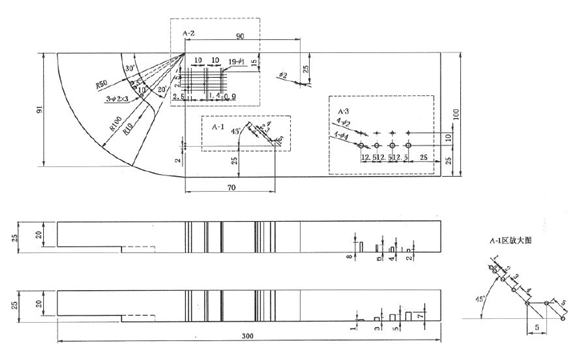
Samples with simple geometric shapes and artificial reflectors, designed and manufactured for specific applications, are usually called test blocks. Test blocks, like instrument probes, are important tools in ultrasonic phased array flaw detection. The role of test blocks: Determine the flaw detection sensitivity.
Type A Test Block Schematic Diagram
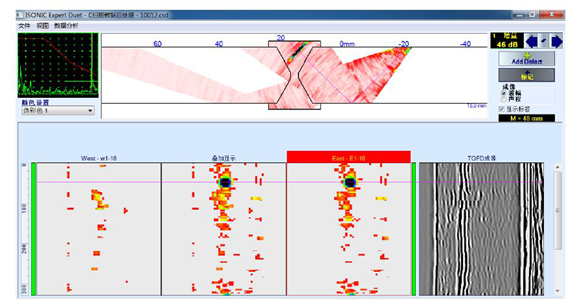
Phased Array Detection Image Display
This information comes from the internet. Please contact us to delete it if there is any infringement.
本资讯源于网络,如有侵权请联系删除。
Previous Page
Previous Page
Contact Us
Room 618, 36 Gaoke Road, Tianhe District, Guangzhou, China
national unified free service hotline:400-020-6788


Copyright©2025 All Rights Reserved of Rencheng (Guangzhou) Medical Equipment Maintenance Co., Ltd.